Welcome to The Ivy League Look

This blog presents a historical view through articles, photographs, reminiscences, and advertisements, of an American style of men's fashion of the mid-20th century known as "The Ivy League Look" or "The Ivy Look."

This blog will not present modern-day iterations of this "look"; it will be shown in its original context as an American style worn during this specific era. Author commentary will be kept to a minimum.

This is not a commercial site and links to commercial sites will not be posted.

Showing posts with label End of Ivy. Show all posts

January 18, 2015

Ghost Story, 1988

(click to enlarge)


(click to enlarge)


All the world may be a stage, but it's still rare that I see a psychological drama played out within a business. At Briggs Ltd., a retail clothing store, the ghost of a father long dead hovered about his son, his voice as harsh and demanding in death as it was in life. It was time for the son to put his own stamp on the company; to do that, he first had to come to terms with his past.
J. H.


The day after he buried his father, Briggs A. Doherty Jr. returned to selling suits at the family clothing store. Already, he felt guilty for disobeying Dad. When I die, the old man had commanded, stuff me in a plastic bag, mail me to the family plot in New Haven, and, for God's sake -- his voice rose -- get back to the store and sell...

Source:

"Ghost Story" by Joshua Hyatt - 07/01/88

May 29, 2013

Positively Essential, 1963

(click to enlarge)
Source:

Brown Daily Herald - 5/31/63

(click to enlarge)
(click to enlarge)
Source:

Brown Alumni Monthly - February 1997

May 17, 2013

Princeton Charlie, 1968


(click to enlarge)


Source:

The Daily Princetonian - 12/8/66

(click to enlarge)


Princeton Charlie is someone we all know. He wears a rep tie, tweed jacket, weejuns and wheat jeans to JP. He takes a bottle of bourbon to the dance and has a case of Colt 45 back at the room. Also back at the room he has all sorts of red and blue lights wired onto a wagon wheel hanging from the ceiling, a Princeton banner on the wall, a wooden bar and a closet full of cocktail accessories, photographic equipment, binoculars, toy tigers and watches.

The incredible thing is not that there are people on this campus whose life-style approximates Princeton Charlie's. The incredible thing is that this should be taken, even by the campus media, as a model or idea when plenty of freshmen aren't sucked in by this bush-league ethos, and most of the ones that are, outgrow it by the end of their sophomore year. Most clubs aren't even interested in Princeton Charlie, the exceptions being those sad clubs of declasse preppies who imagine that he lives on somewhere "down the street." Princeton Charlie is someone we all know; he is also someone we all want to forget.

The intriguing question is why he is with us still. In a sense he is the ghost of an imagined past. For one thing it couldn't have been that bad; for another he is a little too precisely like the daydream of a mid-west high school senior who has just been accepted at Princeton.

He lives on because the U-Store and Orange Key and the administration can use him. He is a way of getting at underclassmen. He is a way of inducing that false consciousness that is so necessary to move goods in a department store which has more to offer a 30-year-old vacuum-cleaner salesman than a student.

The campus media, including the "Prince," can use him because it is always easier for a writer to employ an intrinsically coherent rhetoric, no matter how much that rhetoric offends his own intelligence, his own taste, his own morality.


Source:

The Daily Princetonian - 3/15/68

March 26, 2012

Our Lightweight Cotton Sweater, 1979

(click to enlarge)

Source:

The New Yorker - 9/10/79

COTTON SWEATERS are now basics in many warm-weather wardrobes. But such was not always the case, since traditions, even woolen ones, die hard in men's dressing. Perhaps the turning point came eight years ago, when Brooks Brothers, that bulwark of sartorial propriety, introduced a cotton, cable-stitched, V-neck sweater. It was an instant success and ''is now the bulk of our sweater business for the spring and summer,'' says Peter G. Newman, vice president and merchandise manager for furnishings.

Success was slower in coming for Ron Chereskin, the award-winning men's-wear designer. ''In 1977, I was told that men would not understand cotton sweaters,'' he says. ''Today, my cotton-sweater business does about $10 million at wholesale annually.''

Source:

New York Times Magazine - 5/12/85

January 15, 2012

The Two-Button Suit, 1962

(click to enlarge)


The Ivy League Look is now petering out and the two button suit is back in a burst of presidential glory. [. . . ] Brooks Brothers, the famous stamping ground of the Ivy League look, saw the two button suit revival coming from a long way back. Brooks has been perfecting its new two button collection for two years. President Kennedy's sponsorship of the new style is purely coincidental.

Source:

Capital Times - 2/23/62

November 2, 2010

March 26, 2010

Clothes Revolution, 1968

(click to enlarge)

"At schools like Princeton, Amherst, Harvard, Yale and Virginia, where gray flannel slacks and expensive tweed coats were once the uniform of the day, contemporary male garb revolves around a pair of blue jeans or wash pants, a short-sleeved shirt, scuffed loafers, and a coat with fraying elbow patches.

Fathers who once were outfitted by J. Press, Brooks Brothers, Saks Fifth Avenue and Fenn & Feinstein are puzzled when their sons patronize local Army-Navy surplus stores or university co-ops."

Source:

Parade Magazine - 11/24/68

March 11, 2010

Conformists, WASPs and Preppies, 1968

(click to enlarge)

Source:

New York Times News Service - November 1968

December 7, 2009

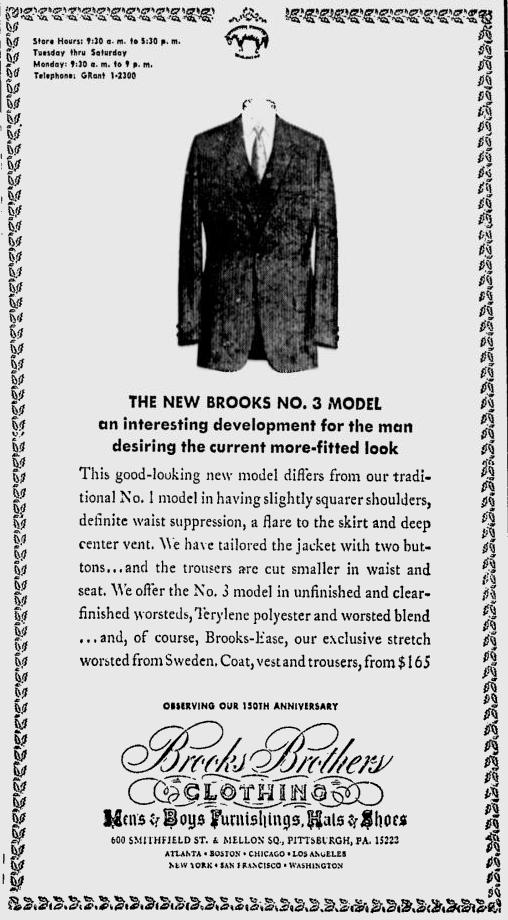
Our New Two-Button Suit, 1961

(click to enlarge)

"...for the man who desires slimmer lines and a slightly more tailored look"

Source:

Pittsburgh Post-Gazette - 9/6/61

November 5, 2009

Well Suited for the White House, 1961


(click each to enlarge)

"As the fashion designers noted with dismay, his business suits fail to conform to current Ivy League fashion in several respects."

"The Kennedy suit is, says Harris, "modern conservative." There is no padding in the shoulders, partly because padding is no longer in style but mainly because the President is broad-shouldered and needs none. The jackets have two buttons instead of the usual three because John Kennedy prefers to wear them that way (and also, says Sam Harris, because Sam Harris prefers to make them that way). Recent reports indicate that two-button suits are coming back into style anyhow, probably owing to the President's example. Harris insists that the presidential lapels are neither too wide nor too narrow; they are, he says, "medium conservative." They are definitely not in the skinny Ivy League mode, however. Neither are the trousers, which are just slightly on the narrow side."

Source:

LIFE magazine - 10/13/61


Source:

Reading (PA) Eagle - 3/31/63

August 8, 2009

What You Will Wear Tomorrow, 1958


(click to enlarge)

"Within the next few years, predicts Bert Bacharach, a leading authority on men’s fashions, you may see the downfall of the Ivy League style. These slender, natural lines, he believes, are as much an exaggeration as the drape cut. Next step, he says, is moderate padding, a bit of a waistline and some semblance of a blade at the shoulders.

What about the distant future? The wonders will continue, experts claim, and before too many years have elapsed episodes like this one may be commonplace: A fellow is out to dinner with his best girl. While staring into her eyes, his hand trembles and a blob of gravy drops on his pants. He just lets it dry, then reaches into a pocket for an eraser and rubs out the spot!

That evening, the same chap surveys himself in a mirror and decides he’d look better in narrower lapels. No fancy tailoring bills for him. He merely takes out a pair of scissors and snips his lapels to the desired width.

He is wearing paper clothes and they are only one of the long-range miracles of masculine [Continued on page 145] fashion foreseen by authorities. Declares Mr. Bacharach: “The changes to come will be utilitarian, not merely a different look. Everything in apparel runs in cycles. We have now reached the zenith of durability in clothes. A suit has a life expectancy of some eight to 12 years. Soon the corner will be turned and suits will have shorter and shorter lives on the theory that men will welcome a good deal of variety in their wardrobes."


Source:

Mechanix Illustrated, October 1958, via Modern Mechanix blog
(via Ivy Style)

July 31, 2009

Hippies Win Fashion Revolution on Campus, 1971

from The Hippy's Handbook, Ruth Bronsteen, 1967

Hippies Win Fashion Revolution on Campus

There is grim news from the National Association of Men's Sportswear Buyers (NAMSB). The mood in the colleges of the nation has created a fashion vacuum on the campuses. The hippies and hard times have won out.

The NAMSB surveyed the fashion picture at the leading colleges and universities throughout the United States and came up with the dismal conclusion that campuses will be a vast sea of blue jeans - patched, frayed, embroidered and cut off blue jeans.

The only ray of light is the report that chinos, or suntans as the army used to call them, are on the upswing - and occasional sparkle of buff among the washed out blues. But that is merely a swing toward Army-Navy clothes and not much help.

The Ivy League look as it used to be called died in the recent fashion revolution and the slope-shouldered, three-button jacket is almost a thing of the past. The suits and sports jackets being worn are strictly for special occasions.

Complete article:

UPI - 9/2/71

July 30, 2009

Notes from the Prep School Underground, 1968

George W. Bush at Andover, 1964

Notes From the Prep School Underground: Drugs and Love Ethic at Exeter, Andover

Prep schools follow the colleges--especially Exeter and Andover, which feed more people into Harvard each year than any other school. Now the slack on the cultural lag has pulled tight for those two schools; and while they glimpse the development of political activism on their campuses, their students are trying out the tragi-comic scene of dropping, blowing, and shooting pot, acid, hash, speed, belladonna, sunflower seeds, airplane glue, freon, Benzedrex Inhaler tubes, Paragoric Pall Malls, Romilar, and Dr. Schein's Asmador Powder.
...

The faculty finally gave in on long hair last winter. And the president of the senior class, Alan Oniskor, wears his very long. The whole student body looks different. Their hair is long. They wear corduroy jackets instead of madras, work shirts instead of Arrow, and boots instead of loafers.


Complete article:

Harvard Crimson - 5/29/68

July 27, 2009

The Man in the Gray Flannel Suit Strikes Again, 1973


(click each to enlarge)

For (Ralph) Lauren, "today's gray flannel suit isn't the old sack, three-button, uptight uniform. There's more individuality in accessories. Today you can wear a striped shirt with gray flannel. We're not bringing back the button-down. And hats are dead except for fun."

Source:

New York Magazine - 9/17/73

July 26, 2009

'Let's Be Practical', 1957

Tailor Denounces Man's Ancient Fashions

By Alfred Leech, UP Staff Correspondent

CHICAGO (UP) - Custom tailor Lawrence Pucci Jr. says men who ridicule feminine fashions should take a look at themselves.

The Ivy League look was bad enough, said Pucci, president of the Assocation of Custom Tailors and Designers of America. But now comes the "Edwardian look."

This consists of narrow cuffless pants with belted backs and narrow jackets with cuffs on the sleeves. A fashion note proclaims that these duds will be worn by "style conscious men as an assertion of their individualality."

"Ludicrous," said Pucci, who makes clothes for some of America's best dressed males. "Here we are in the dawn of the space age, with Sputniks circling the earth, and we're digging back into the fashion attic to don grouse hunting suits.

"Clothes like these should be worn against a backdrop of castles and manor houses."

He conceded that Ivy League garb might be permissible for "boys in school," especially if the school has Ivy-covered walls or Gothic architecture.

But a man stepping into a turbo-jet plane or a new sports car looks foolish in "horse and carriage raiment," Pucci said.

"Surrounded by modernity, we're trying to dress like Diamond Jim Brady or Sherlock Holmes," he said, "it's an idiotic affectation."

There is a "crying need for original thought" in men's attire, Pucci said.

The ideal suit, he said, could be worn anywhere, regardless of season, climate, or occasion.

"A businessman who starts his day in Chicago or New York may well finish it in San Francisco, Miami, or Toronto," he said. "So his clothing should be that adaptable."

"He should be able to attend the theater on night, a party the next afternoon and a prizefight that night, wearing the same suit."

But before we reach this ideal, Pucci said, we may have to shed some foibles like neckties, lapels and shoes that lace in the archaic manner of a Roman sandal.


Source:

The Deseret News and Telegram, Salt Lake City, Utah - 11/21/57

July 23, 2009

"...we've been at the forefront" - J. Press, 1968

(click to enlarge)

Ivy League succumbs to fashion revolution

The Peacock Revolution has hit the Ivy League a staggering blow. The ivy covered campuses now sparkle with colored shirts instead of traditional button-downs and there are darts under the armholes of the classic three button suits.

Such centers of learning as Yale, Harvard and Princeton have been bastions of conservatism since the day they were founded and their shadow of conformity has spread across the land to engulf almost every college and university.

The high priest of the Ivy League look might well be Irving Press and his temple the firm known as J. Press, which has its roots at Yale University, but by this fall will spread as far as San Francisco where barefoot, beaded students at Berkeley may be exposed to eastern sartorial culture.

The so-called Peacock Revolution is, of course, the fashion revolution that has come over the men's wear industry in the past four or five years so we dropped in at J. Press the other day to see if the revolution had caught up with the staunchly conservative Ivy League.

Irving Press, who is president of the firm, said indeed yes and that in certain areas the Ivy League was five or six years ahead. He cited in particular the four-inch-wide tie and said it had met with wide acceptance, especially by some elderly Elis who had never become resigned to the fact that the wide tie had gone out of style.

There has been shape in Ivy League suits for some time now, achieved by placing darts under the armholes, and there has even been extreme shape in British style hacking jackets (made in Ireland) which achieve even more shape by placing darts in the front.

"Actually we've been in the forefront," Press said, "with a flair for color and the first use of the country suit." The country suit is a matching coat and pants in a bright district check, long worn in the British countryside but once considered a bit too racy for the American countryside. They are very new for Fall 1968 on the non-Ivy market but Press admits he has been making them for five years or so.

Colorful

The colors are even brighter, woven into a new and heavier Saxony wool which has a greater concentration of colors than the softer Shetlands which were popular for years, probably because they were on the conservative (drab) side.

Summer suits even have two buttons instead of the classic three and there are deep side vents - something never really accepted in Ivy League circles. And they are distinctly shaped. By Fall they could even be more so - plus the addition of hacking jackets with angled pockets and ticket pockets and more flair to the jacket skirt.

Another innovation from the Ivy League were British Grenadier guardsmen type coats - double breasted, flared, broad lapels.

Another was the steep ridge cavalry twill which is now the rage in Peacock Revolution circles. Press has been using this for years, especially in the hacking jackets which are made in Ireland to his specifications. They also show up in a revival of the belted Norfolk jacket.

As for shirts, wide spread collars are taking the place of the button downs, and a non-button button down which can be worn with or without a pin. The fashion colors are policeman blue, cantaloupe or olive - and those colors are in sports shirts which also are losing their buttons.

A sidelight to the term "Ivy League." Many manufacturers hate the expression and refer to "soft shoulder" or "natural shoulder" suits - a practice which has led manufacturers of should to advertise "natural shoulder shoes" in the trade publications.

As for the Nehru type jacket for the Ivy League crowd, Press was less than enthusiastic. "We have a few rich customers who may order one and throw it away after wearing it to a party but whether there is a germ in this for the future remains to be seen," he said.

Article source - UPI, May 1968

J. Press advertisement - Yale Daily News, June 1968

June 17, 2009

Tiger Rags


A key aspect of student culture that changed with some frequency was personal appearance. Like their college peers elsewhere, young Princetonians were keenly responsive to national fashion trends for both youth and adults, particularly those emanating from New York clothiers, from which many of their fathers took their sartorial cues. But for the first six decades of the last century they also tried to fashion a recognizable "Princeton style," whose distinctiveness some popular magazines were all too ready to certify. In most aspects, however, these various expressions of Tiger fashion were widely shared with - if not borrowed from - other eastern colleges, especially their Big Three competitors in all things. The "Princeton Look" was in reality an "Ivy Look," which in turn was largely traceable to an eastern prep school template. Only when Princeton diversified its student body, when the numerical and social dominance of prep schoolers declined substantially in the 1960s and the attendant "cultural revolution" took adolescent fashion in strange new directions, did Princeton dress drift away from a single stereotype. A partial return to "preppiness" in the late 1970s could not prevent the new-millennial "Princeton Look" from resembling ever so strongly the sartorial heterogeneity of most American campuses.

Source:

The Making of Princeton University, James Axtell, 2006

June 1, 2009

Ivy League Look is Now Thing of Past, 1958

Fashion Experts Say Ivy League Look Is Now Thing of Past

The California Men's Apparel Club, currently conducting showings for buyers here, says the Ivy League look is a thing of the past. It's retreating to the Eastern campuses whence it came.

"The young executive look is the thing now," a Calmac spokesman said.

What's the difference?

The "young executive" is not so tight or short in the trouser legs.

"More what a young banker would wear," the spokesman observed.

Other trends: Colors are dark. Ties are a little wider and whiter, the three-button sack suit is still tops, materials are lighter in weight and synthetics are king.


Source:

Ocala (Florida) Star Banner - 1/13/58