Welcome to The Ivy League Look

This blog presents a historical view through articles, photographs, reminiscences, and advertisements, of an American style of men's fashion of the mid-20th century known as "The Ivy League Look" or "The Ivy Look."

This blog will not present modern-day iterations of this "look"; it will be shown in its original context as an American style worn during this specific era. Author commentary will be kept to a minimum.

This is not a commercial site and links to commercial sites will not be posted.

Showing posts with label 1968. Show all posts

January 13, 2015

"Belong" on Any Campus, 1965

(click to enlarge)
Source:

The Bowdoin Orient - 10/1/65

(click to enlarge)
A.H. Benoit Co. clothing store, 1966 1968. Benoit's had stores in Westbrook, Portland, Biddeford, Brunswick, Lewiston and Ogunquit.

Source:

Maine Historical Society

July 27, 2013

Support Your Party, 1968

(click to enlarge)
Source:

The New Yorker - 7/27/68

May 17, 2013

Princeton Charlie, 1968


(click to enlarge)


Source:

The Daily Princetonian - 12/8/66

(click to enlarge)


Princeton Charlie is someone we all know. He wears a rep tie, tweed jacket, weejuns and wheat jeans to JP. He takes a bottle of bourbon to the dance and has a case of Colt 45 back at the room. Also back at the room he has all sorts of red and blue lights wired onto a wagon wheel hanging from the ceiling, a Princeton banner on the wall, a wooden bar and a closet full of cocktail accessories, photographic equipment, binoculars, toy tigers and watches.

The incredible thing is not that there are people on this campus whose life-style approximates Princeton Charlie's. The incredible thing is that this should be taken, even by the campus media, as a model or idea when plenty of freshmen aren't sucked in by this bush-league ethos, and most of the ones that are, outgrow it by the end of their sophomore year. Most clubs aren't even interested in Princeton Charlie, the exceptions being those sad clubs of declasse preppies who imagine that he lives on somewhere "down the street." Princeton Charlie is someone we all know; he is also someone we all want to forget.

The intriguing question is why he is with us still. In a sense he is the ghost of an imagined past. For one thing it couldn't have been that bad; for another he is a little too precisely like the daydream of a mid-west high school senior who has just been accepted at Princeton.

He lives on because the U-Store and Orange Key and the administration can use him. He is a way of getting at underclassmen. He is a way of inducing that false consciousness that is so necessary to move goods in a department store which has more to offer a 30-year-old vacuum-cleaner salesman than a student.

The campus media, including the "Prince," can use him because it is always easier for a writer to employ an intrinsically coherent rhetoric, no matter how much that rhetoric offends his own intelligence, his own taste, his own morality.


Source:

The Daily Princetonian - 3/15/68

May 9, 2013

Fine Tweeds. Fine Flannels. Fine Sharkskins. (1949)

(click to enlarge)

Straight lines. Soft front construction. Soft-rolled lapels. Minimum squaring of the natural shoulder. Center vent.

Source:

The Daily Princetonian - 5/9/49


"MOST CUSTOMERS KNOW WHAT THEY WANT," is the experience of 54 years on Nassau Street by Bernie Olbrys (left) and Joe Cox of the new Country Squire, gleaned during the years when the store was known as Douglas MacDaid. "Quite a few women come in to help buy -- but some men don't like their wives to come with them."

Source:

Town Topics - 10/17/68

October 22, 2011

Camel's Back, 1958

(click to enlarge)
Source:

The New Yorker - 10/25/58

Shortly after the close of the World War, S. Stroock & Co., Inc., in its own laboratories, and with the aid of specialized chemists, skilled textile machinery technicians and intensively drilled workmen, began in its mills at Newburgh-on-Hudson, N.Y., a series of exhaustive experiments with the determination to produce commercially a cloth of 100% pure,  fine camel hair through the exhaustive use of the "noil" and the finest portion of the No. 1 Quality fibre after continuous combing. [. . .] The accomplishment of this task, the development by Stroock of this wholly-new method of processing 100% pure, fine camel hair - the production of a cloth "fit for a king," yet available to all - is today still one of the rare and outstanding achievements of Western World textile manufacturing, and so recognized throughout the length and breadth of Occidental countries.

Source:

The Story of Camel Hair by S. Stroock & Co., 1936

(click to enlarge)

 Source:

The Evening News - 11/8/68

Update:

(click to enlarge)
Source:

The Evening News - 6/15/85

December 9, 2010

November 2, 2010

August 31, 2010

Own Make motif neckwear, 1968

(click to enlarge)


Source:

New York Magazine - 12/2/68

March 26, 2010

Clothes Revolution, 1968

(click to enlarge)

"At schools like Princeton, Amherst, Harvard, Yale and Virginia, where gray flannel slacks and expensive tweed coats were once the uniform of the day, contemporary male garb revolves around a pair of blue jeans or wash pants, a short-sleeved shirt, scuffed loafers, and a coat with fraying elbow patches.

Fathers who once were outfitted by J. Press, Brooks Brothers, Saks Fifth Avenue and Fenn & Feinstein are puzzled when their sons patronize local Army-Navy surplus stores or university co-ops."

Source:

Parade Magazine - 11/24/68

March 11, 2010

Conformists, WASPs and Preppies, 1968

(click to enlarge)

Source:

New York Times News Service - November 1968

January 14, 2010

Harvard Beats Yale 29-29, 1968

Alumni Day, Harvard, 1968


"Stunning the Yale defense with two touchdowns, two two-point conversions, and an onside kick, the Crimson played its way back into the game and into the annals of history. The final score may have been a tie, but the celebratory home crowd rushing the field indicated that it was anything but, leading The Crimson to print its famed headline “Harvard beats Yale 29-29.” (The Harvard Crimson, 11/21/08)

You could do worse with your time than spend 105 minutes of it watching the documentary "Harvard Beats Yale 29-29", as I did last week. There's not a second devoted to The Ivy League Look, but don't let that stop you. And if you suffer from severe politicophobia, don't worry. While both Al Gore (Harvard '69 and roommate of Tommy Lee Jones, who played offensive guard for Harvard) and George Bush (Yale '68, first cousin of the filmmaker and roommate of Yale tackle Ted Livingston) are mentioned, neither appear in the film.

December 10, 2009

J. Press Shaggy Dog ®, 1968

(click to enlarge)


...and for just $6 more be sure to get a "Turtle Neck Bib."

Source:

Yale Daily News - 9/3/68

October 22, 2009

Paul Stuart raincoat, 1968

(click to enlarge)

Source:

New York Magazine - November 4, 1968

October 13, 2009

Shetland Cable Knit, 1968

(click to enlarge)

Source:

Yale Daily News - 9/26/68

September 30, 2009

August 9, 2009

The J. Press Necktie Collection, 1968

(click to enlarge)


Source:

Yale Daily News - 12/18/68

July 30, 2009

Notes from the Prep School Underground, 1968

George W. Bush at Andover, 1964

Notes From the Prep School Underground: Drugs and Love Ethic at Exeter, Andover

Prep schools follow the colleges--especially Exeter and Andover, which feed more people into Harvard each year than any other school. Now the slack on the cultural lag has pulled tight for those two schools; and while they glimpse the development of political activism on their campuses, their students are trying out the tragi-comic scene of dropping, blowing, and shooting pot, acid, hash, speed, belladonna, sunflower seeds, airplane glue, freon, Benzedrex Inhaler tubes, Paragoric Pall Malls, Romilar, and Dr. Schein's Asmador Powder.
...

The faculty finally gave in on long hair last winter. And the president of the senior class, Alan Oniskor, wears his very long. The whole student body looks different. Their hair is long. They wear corduroy jackets instead of madras, work shirts instead of Arrow, and boots instead of loafers.


Complete article:

Harvard Crimson - 5/29/68

July 23, 2009

Dear Mr. Juster...

Dear Mr. Juster,

What do you think of a man of 47 wearing the same style clothes as his 17-year-old son? My husband thought that Tom looked so great in his Ivy League suit, he bought one himself. I know this is what the kids are wearing, but for a mature man...? - Mrs. L.J.

Time was when a boy dressed like his father. Now, father emulates his son. And why not? If your husband hasn't developed that middle-age spread and has retained a fairly slim build, he will look as smart as Tom in his Ivy model, even though he carries a brief case, instead of books, under his arm. (1962)
_________________________

Dear Mr. Juster:

I recently started working for an advertising agency and notice all the fellows dress in Ivy suits. Every time I've tried Ivy my sloping shoulders look even more sloping, but my wife still thinks I should dress the same way.

Now, I ask you - is it smart to conform, or risk standing out like a sore thumb among my associates? -J. N.

This business of trying to conform by wearing what everybody around you wears, regardless of the effect on appearance, is one of my pet peeves.

Forget about what your associates are wearing and stay to the kind of clothes that do something for you. In this case, it's a model designed with shoulders that help build up yours.
(1964)
________________________

Dear Mr. Juster:

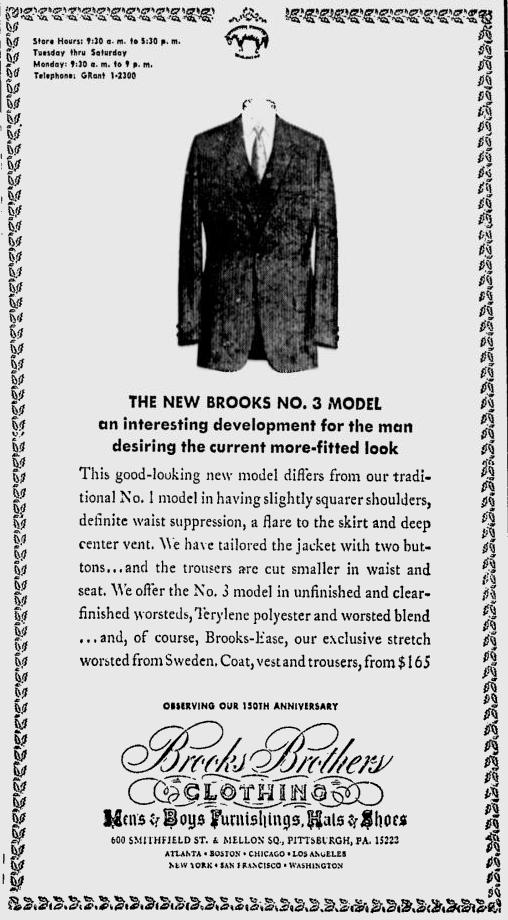
I go to the University of Michigan and wear Ivy type clothes. Recently, I bought a sport coat and it's two-button instead of three. Also, the sides curve in a little, and it has a long vent.

I was told this is for college men but a couple of guys in our fraternity say I got took because no natural shoulder wearer would be seen in this style. Now, I'm wondering if I goofed. - L.W.R.

No, you didn't. Natural shoulder styling is no longer confined to the three-button, straight hanging cut.

Variations in models, such as the one you bought, with shaped waist and deep vents are now available. And, regardless of your fraternity brother's opinion, I say this is a welcome development. Why must you be limited to one model?
(1968)


[Ed. note: Harry Juster was a syndicated columnist writing on men's fashions in the 1960s. He wrote a book titled Clothes Make the Man in 1965.]